Z47
May 15, 2025

Unlocking Hypergrowth: How Great Products Sell Themselves

No items found.
No items found.

Product-Led Growth isn't just a buzzword; it's a paradigm shift reshaping how companies, particularly in SaaS, build and scale. I had an illuminating conversation with Shubham Choudhary, a Product and Growth leader, whose experience at Swiggy and Quizizz provides a unique lens into the power of PLG. In this article, I’ll share some of the core concepts and actionable insights he shared.

PLG is a Philosophy, Not a Feature

At its core, PLG is about creating a product that’s so valuable, intuitive, and accessible that users become your growth engine. It’s not about replacing the sales team, it’s about letting the product do the heavy lifting.

“PLG is not freemium. It’s about delivering value fast, and letting users discover it for themselves,” says Shubham.

So what does that actually require?


1. Start With a Soul-Level Pain Point

“You need to hit a deep, soul-core pain point that people talk about.”

The best PLG products don’t just fill a gap, they fix something that’s fundamentally broken. They serve a need so urgent and unresolved that users can’t help evangelize them.

Figma for instance, didn’t just offer a design tool, it solved the chaos of collaborative design. That kind of pain, once resolved, creates word-of-mouth by default.

2. Design for Inherent Virality

PLG products are built with distribution baked in. The experience is designed to spread, like multiplayer modes, sharing flows, or collaboration loops.

“I still share the design with you so you will get Figma. That creates a need and maybe a future conversion.”

Virality isn’t a bonus. It’s architecture.

3. Time to Value: 10 Seconds or Less

“New users are lazy, vain, selfish. You have 10-15 seconds to deliver value.”

Onboarding shouldn’t be an afterthought. A PLG product must hit fast: showing users immediate payoff before they bounce. That means stripping friction, surfacing delight, and removing any work that delays gratification.

4. Product-Driven Conversion

In sales-led models, marketing generates interest, sales nurtures the lead, and the product comes last. In PLG, the product is the funnel:

  • Freemium = acquisition
  • Activation = engagement
  • Usage = qualification
    Expansion = conversion

“You need fewer salespeople, because your product is doing the qualifying. Sales just needs to convert,” Shubham explains.

This is why PLG doesn’t kill sales, it just gives it leverage.

5. PLG vs SLG: Different Machines

One isn’t better than the other, they just scale differently:
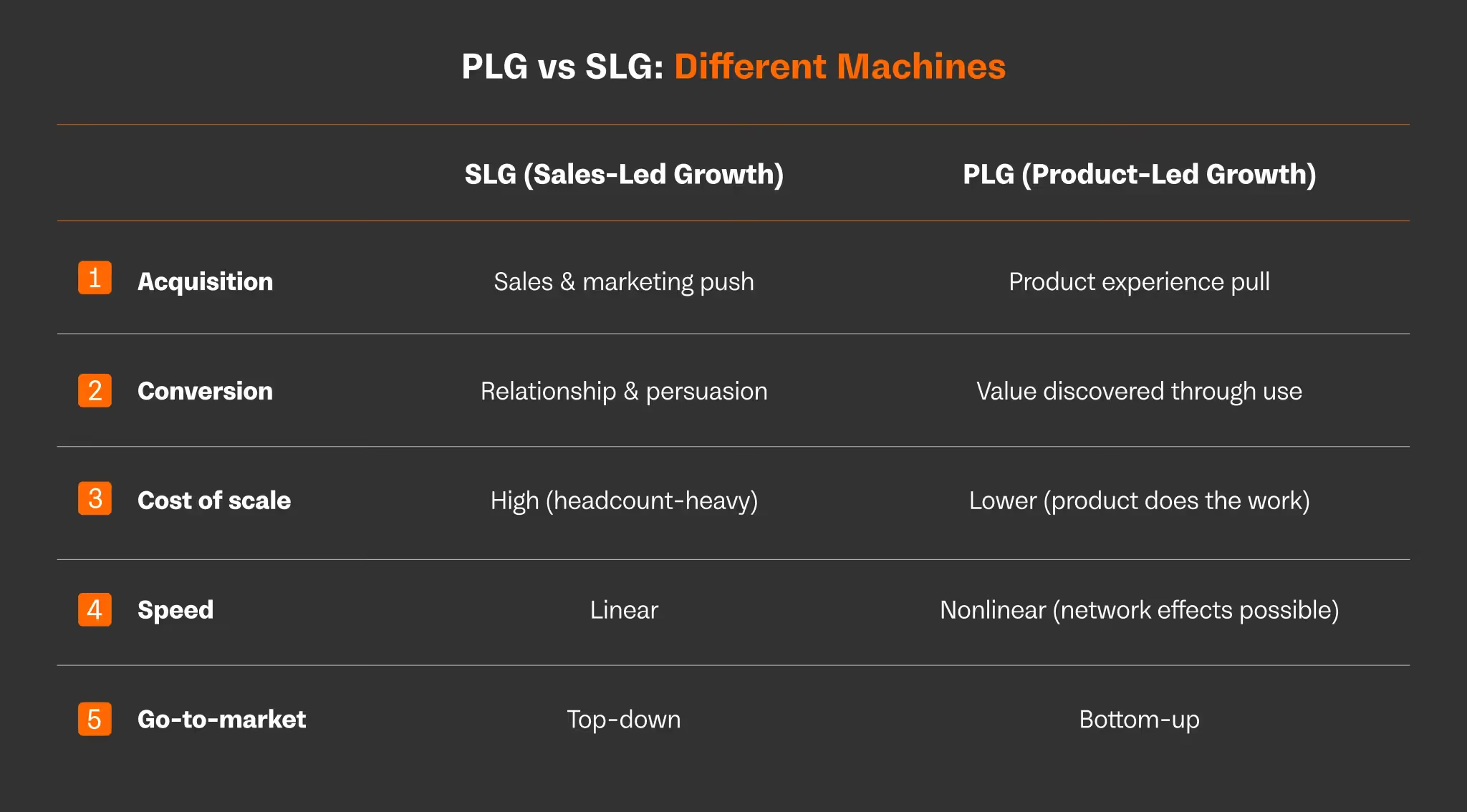
In the right setup, both models can coexist, especially in hybrid B2B plays.


7. PLG in B2B vs B2C: Know the Terrain

  • B2C PLG = delight + virality. Like Duolingo, Notion, Calendly.

  • B2B PLG = usage-first, sale-later. You earn your way up from end users to buyers.

The mechanics differ. But the mindset remains the same: let the product lead.

8. What Great PLG Demands

Shubham distills PLG down to a few core operating principles:

  • Deep Insight
    Understand your user’s pain better than they do. Get into their workflows, emotions, and hacks.

  • Creative Execution
    Insight alone isn’t enough. You need to ship solutions that feel effortless to the user.

  • Rapid Experimentation
    “It’s a loop: observation → hypothesis → test → insight → repeat.”

  • Clarity Over Cleverness
    Your product should explain itself. No walkthroughs, no training. Value must be self-evident.

  • Obsess Over Time to Value
    Every delay is a drop-off. Every click is a decision. Cut everything you can.

Final Take

PLG isn’t a playbook, it’s a practice. You don’t sell the product. You design it to sell itself.

It starts by solving real pain. It spreads by making users your channel. And it scales by putting product at the center, not at the end, of your go-to-market.

For builders who get it right, growth becomes not just faster, but more sustainable.

For more information, write to us: namaste@Z47.com.
Stay connected with Z47.

Watch more such podcasts

Z47
July 1, 2026

One Index. The next decade of Indian equities.

Z47
January 14, 2026

The formula for India’s AI moment is DPI^AI

Z47
May 12, 2025

Founders, VCs , and the Art of Board Meetings 
by Tarun Davda

Z47
May 15, 2025

Unlocking Hypergrowth: How Great Products Sell Themselves

No items found.
Article
Listen to article

Product-Led Growth isn't just a buzzword; it's a paradigm shift reshaping how companies, particularly in SaaS, build and scale. I had an illuminating conversation with Shubham Choudhary, a Product and Growth leader, whose experience at Swiggy and Quizizz provides a unique lens into the power of PLG. In this article, I’ll share some of the core concepts and actionable insights he shared.

PLG is a Philosophy, Not a Feature

At its core, PLG is about creating a product that’s so valuable, intuitive, and accessible that users become your growth engine. It’s not about replacing the sales team, it’s about letting the product do the heavy lifting.

“PLG is not freemium. It’s about delivering value fast, and letting users discover it for themselves,” says Shubham.

So what does that actually require?


1. Start With a Soul-Level Pain Point

“You need to hit a deep, soul-core pain point that people talk about.”

The best PLG products don’t just fill a gap, they fix something that’s fundamentally broken. They serve a need so urgent and unresolved that users can’t help evangelize them.

Figma for instance, didn’t just offer a design tool, it solved the chaos of collaborative design. That kind of pain, once resolved, creates word-of-mouth by default.

2. Design for Inherent Virality

PLG products are built with distribution baked in. The experience is designed to spread, like multiplayer modes, sharing flows, or collaboration loops.

“I still share the design with you so you will get Figma. That creates a need and maybe a future conversion.”

Virality isn’t a bonus. It’s architecture.

3. Time to Value: 10 Seconds or Less

“New users are lazy, vain, selfish. You have 10-15 seconds to deliver value.”

Onboarding shouldn’t be an afterthought. A PLG product must hit fast: showing users immediate payoff before they bounce. That means stripping friction, surfacing delight, and removing any work that delays gratification.

4. Product-Driven Conversion

In sales-led models, marketing generates interest, sales nurtures the lead, and the product comes last. In PLG, the product is the funnel:

  • Freemium = acquisition
  • Activation = engagement
  • Usage = qualification
    Expansion = conversion

“You need fewer salespeople, because your product is doing the qualifying. Sales just needs to convert,” Shubham explains.

This is why PLG doesn’t kill sales, it just gives it leverage.

5. PLG vs SLG: Different Machines

One isn’t better than the other, they just scale differently:

In the right setup, both models can coexist, especially in hybrid B2B plays.


7. PLG in B2B vs B2C: Know the Terrain

  • B2C PLG = delight + virality. Like Duolingo, Notion, Calendly.

  • B2B PLG = usage-first, sale-later. You earn your way up from end users to buyers.

The mechanics differ. But the mindset remains the same: let the product lead.

8. What Great PLG Demands

Shubham distills PLG down to a few core operating principles:

  • Deep Insight
    Understand your user’s pain better than they do. Get into their workflows, emotions, and hacks.

  • Creative Execution
    Insight alone isn’t enough. You need to ship solutions that feel effortless to the user.

  • Rapid Experimentation
    “It’s a loop: observation → hypothesis → test → insight → repeat.”

  • Clarity Over Cleverness
    Your product should explain itself. No walkthroughs, no training. Value must be self-evident.

  • Obsess Over Time to Value
    Every delay is a drop-off. Every click is a decision. Cut everything you can.

Final Take

PLG isn’t a playbook, it’s a practice. You don’t sell the product. You design it to sell itself.

It starts by solving real pain. It spreads by making users your channel. And it scales by putting product at the center, not at the end, of your go-to-market.

For builders who get it right, growth becomes not just faster, but more sustainable.

We are excited about the innovation and growth opportunities in this sector.

If you are considering building in the footwear space, we’d love to chat.
Drop us a line at consumer@matrixpartners.in

Learnt something new? Follow us!

Vs NIFTY 500
+9.1%
Since Jan 2024
USD/INR
₹95.19
▲ +0.6%
Daily change • 1 Ju1 2025
128.1
▲ +28.1%
Since Jan 2024
NIFTY 500
129.1
▲ +19.0%
Since Jan 2024

Index Performance

+28.1%
Since Jan 2024
NIFTY 500
+19.0%
Since Jan 2024

Z47^fortyseven is up +23.9% since its January 2024 base date, versus Nifty 500's +18.4%, ahead by 550 bps.

The cohort moved +4.7% over the month versus Nifty 500's +2.5%, leading by 220 bps.

Anchored in domestic demand and rising digital adoption, the cohort remained resilient amid global headwinds.

Consumer Tech was the best-performing sector at +9.2% last month, driven by sustained growth in consumer demand and strength in consumer-internet platforms.

Largest Constituents  ·  The Names That Anchor The Index

1.
Eternal
Quick-commerce leadership and continued investment
▲ +12.8%
2.
Groww
Broking market-share gains and margin-funding growth.
▲ +10.4%
3.
Lenskart
Store densification and margin expansion.
▲ +2.4%

Top Gainers  ·  Key Drivers

1 MONTH RETURN
1.
CarTrade
Auto-marketplace dominance and a cash-rich balance sheet.
▲ +59.4%
2.
 Amagi Media Labs
Profitability turnaround and AI-led cloud media adoption.
▲ +31.4%

Top Laggards  ·  Key Drivers

1 MONTH RETURN
1.
Fractal Analytics
Enterprise AI spending trends and post-listing share supply.
▼ -10.8%
2.
MedPlus Health
Pharmacy-margin pressure and competitive intensity.
▼ -6.6%

Key Themes  ·  Latest Results

In Q4FY26, Z47^fortyseven's cohort grew top line ~39% YoY, more than 3x the broad market's ~12% growth.

Operating leverage lifted net margins around 500 bps into positive territory, even as broad-market net margins remained roughly flat.

With 40 of 47 companies now profitable, the cohort reflects a broader shift toward profitable growth over growth at any cost.

AI adoption runs deeper across this cohort than in the broader market, with companies using it to drive growth and reshape demand, not just improve efficiency.

Cash generation is increasingly defining the winners, enabling market leaders like Eternal, CarTrade, and PB Fintech to fund acquisitions and expansion from their own balance sheets.

Market & Macro Context

The cohort saw several block deals this month, including sizeable stake sales in Lenskart, Delhivery, Honasa, and Shadowfax.

Ownership continues to shift from foreign investors to domestic institutions, creating a more durable shareholder base.

AI remained the defining technology investment theme, driving capital deployment across both private and public markets.

IPO Takeaway · Kissht

Listed May 2026

A modest listing pop followed by strong post-listing gains reinforced the market's preference for asset quality and disciplined underwriting over pure loan-book growth.

The listing helped reset perceptions around unsecured lending, creating a constructive valuation anchor for the issuers that follow.

The buyer mix was a notable positive — strong participation from long-only domestic institutions supporting a durable post-listing ownership base.

Net Read

Fundamentals continued to strengthen across the cohort, with growth, margins, and cash generation improving in tandem.

Performance dispersion widened, with profitability and earnings quality increasingly distinguishing the strongest performers from the rest.

Disclaimer

Z47^fortyseven is published for informational purposes only and does not constitute investment advice, or any offer, solicitation, or recommendation to buy or sell securities. Index performance is historical and should not be construed as indicative of future results.

Explore the live index
Read Previous Article On Land & Expand
Read Next Article On Land & Expand